What is intensive therapy?
A therapy intensive is a concentrated block of clinical work delivered across several days or a few weeks, in place of the weekly hour that most people associate with therapy.
This page sets out what that actually means, where the format came from, why concentrated time changes what is clinically possible, who it suits, and how it compares with the other options available to someone in difficulty.

What actually distinguishes an intensive from ordinary sessions booked close together
The instinct can be to think of an intensive as several ordinary sessions compressed into a shorter window. That is not quite right and the difference is important.
An intensive begins before the first day. Assessment and history are taken in advance, so the work itself starts at working depth rather than at introduction. In practical terms, this means the first hour of an intensive is not spent finding out who someone is or what brought them there. That has already happened, as has the solid commitment the client is making to the therapeutic process by choosing this approach; the work has begun at the commencement of the intensive container.
The work itself is conducted across longer clinical days and typically organised around a defined focus, trauma, upcoming life event or goal. A longer clinical day is definitely not the same as a longer version of a fifty-minute session repeated back to back. It is structured, paced, and sequenced with a flexible yet very intentional arc, in the way a single session is, but across a much larger unit of time.
Concentrated clinical work also needs somewhere to land after the intensive, and agreement on what next steps and support is needed is paramount to the process.
Preparation, structure, and integration are what make an intensive a distinct format. Remove any one of them, and you'd just be looking at several sessions held on consecutive days, which is a different thing. The real beauty of an intensive is how it allows the healing space to expand and grow in a very unique and spacious way.
Where the format comes from
The idea of concentrated clinical time is not new. Long before "intensive" became a more common, albeit still quite rare, term in private practice, residential settings already understood something that ordinary weekly practice took longer to formalise: that certain clinical work benefits from sustained, uninterrupted attention rather than an hour a week stretched across months.
What has changed more recently is the emergence of the intensive as a standalone format, delivered without residential admission, built specifically around the idea that concentrated time itself does something a fifty-minute hour cannot, regardless of the particular therapeutic approach used within it. The format has developed across multiple clinical traditions (such as IFS, EMDR, couples work and more) independently, which is itself a signal that something structural, needed and desired by clients, not just a new trend, is being responded to.
Why concentrated time changes what is possible
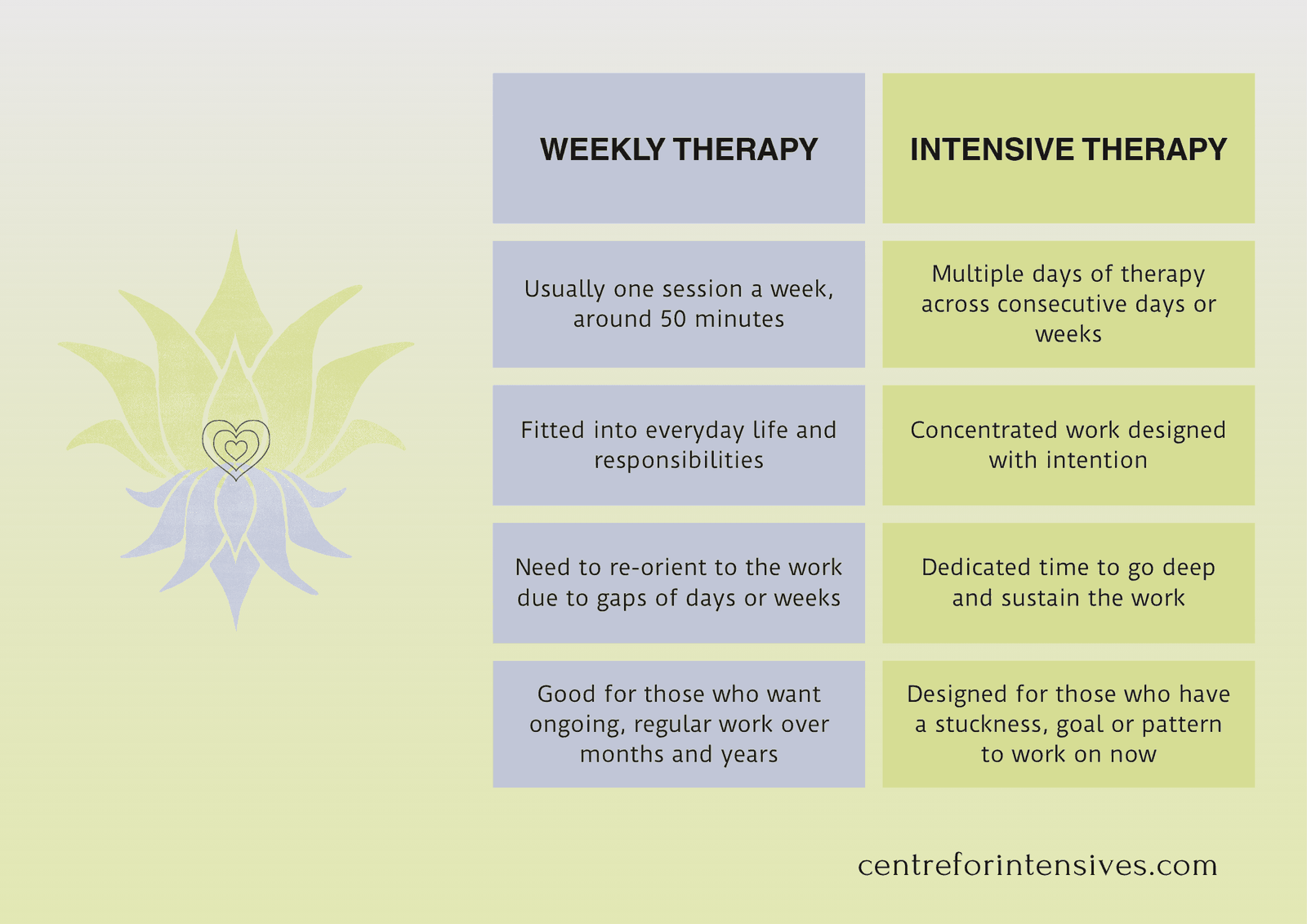
Weekly therapy necessarily spends a portion of every hour re-establishing where the work had reached and what has happened in the gap between. That re-entry is not unimportant, it is what the regular therapy structure requires, and for a great deal of clinical work, the weekly rhythm remains the right choice.
But the cumulative time spent reacclimatising has a cost. Material that was close to the surface at the end of one session has often settled again by the next. A week of ordinary life, events and grievances sits between one hour and the next, and much of what made the previous session possible has to be rebuilt before the work can continue from where it left off.
Consecutive days remove much of that limitation. Work that opens on the first afternoon is often still open on the second morning. The material stays live between one piece of clinical work and the next, rather than being closed and reopened, closed and reopened, across separate weeks.
This is not simply a theoretical claim about structure. A 2018 randomised clinical trial found that a massed, daily format of prolonged exposure therapy for PTSD reduced treatment dropout by nearly half compared with standard weekly delivery, while producing equally significant symptom improvement. A follow-up 2023 randomised trial of 234 military personnel and veterans found that compressed formats of the same therapy, delivered daily over three weeks, produced large and clinically meaningful reductions in PTSD symptoms, with roughly half of participants no longer meeting diagnostic criteria for PTSD at six months. In couples work, a 2022 longitudinal study of an intensive model of couples therapy found statistically significant increases in marital satisfaction at one month post-treatment, sustained at twenty-four months, among 118 married couples.
Neither finding is a claim that every intensive produces these results for every person. What the evidence supports is narrower yet useful: that concentrated, consecutive-day formats are a genuinely studied clinical structure, not simply a scheduling convenience, and that in at least these well-documented cases, the format held its effects over time rather than fading once treatment ended.
Who an intensive tends to suit, and who it does not
No format suits everyone, and an honest account of an intensive has to include where it is the wrong answer as much as where it is the right one.
An intensive may suit someone who can describe their own pattern with real precision and detail, and who has been unable to shift that pattern despite consistent insight or even weekly work. It may suit someone whose functioning looks intact from the outside while something quite different is happening underneath, where the gap between the two has become difficult to sustain. It can suit someone whose working pace or location makes reliable weekly attendance genuinely unrealistic, a practical reason rather than a clinical one, but a very real one. It can suit someone in a particular kind of freeze, still managing to show up and perform a role, while privately or relationally unable to move. And it can suit someone who has enough stability to engage in intensive clinical work, but whose difficulties would benefit from sustained attention rather than a weekly fifty minutes.
An intensive is generally not the right answer where there is acute risk to life. A higher level of clinical care is the appropriate response in that situation, and an intensive is not a substitute for it. It is usually not the right answer where someone needs containment held steadily over an extended period, since weekly work, with its regular rhythm and built-in pacing, is often the safer structure for that kind of ongoing holding. Where a difficulty is situational and recent rather than longstanding, an intensive may simply be more than the situation calls for. And where the primary need is rest and the removal of demand, rather than active treatment, a period of medical leave may address that more directly than therapy itself.
That judgement, in every case, is made at assessment, before anything is booked.
How an intensive differs from a retreat
A retreat is organised around a setting, days away, often in a restorative or natural environment, with therapeutic elements built into a broader experience that may also include rest, reflection, or group activity.
An intensive is organised primarily around a clinical structure, not a location. It can be delivered online or in person, and where it takes place is a secondary decision, not the defining feature. The defining feature is the sequence: assessment, structured days of focused and spacious clinical work, and integration. A retreat may contain elements of that, but the term itself describes an experience, where an intensive describes a clinical method.
How an intensive differs from residential treatment
Residential treatment involves staying within a treatment setting for an extended period, typically weeks, with round-the-clock care, multidisciplinary support, and structured supervision built around someone who needs a level of holding this format cannot provide.
An intensive is delivered without residential admission. The person returns to their own life each evening, or between blocks of days, rather than remaining within a clinical setting. This makes an intensive suitable for a different population than residential treatment: someone whose functioning is largely intact and who does not require round-the-clock support, but who needs more sustained attention than a weekly hour allows.
How an intensive differs from an EAP referral
An Employee Assistance Programme referral typically offers short-term, often brief, structured support, usually a limited number of standard sessions, intended to address an immediate difficulty and connect someone to further care if needed.
An intensive is a more sustained, more clinically involved piece of work, and it is not typically the first point of contact in a crisis. Where an EAP referral may represent the front door, an intensive is closer to a considered next step, for someone whose difficulty has already been identified and who is ready for concentrated work on it.
How an intensive differs from a leave of absence
A leave of absence removes demand. Its purpose is rest, space, and stepping back from the pressures of a role, without necessarily involving active clinical work at all.
An intensive is active clinical work. It does not remove someone from their life in the way a leave of absence does, and it is not primarily about rest. Where the actual need is a reduction in load, a leave of absence is the more direct answer. Where the need is to work through something specific, an intensive is.
What actually happens during an intensive
Before the first day, assessment and history-taking establish whether an intensive is appropriate at all, and if so, what it needs to focus on. This stage is where the judgement described above, whether this format suits this person, at this moment in time, is actually made.
During the days themselves, the work follows a structure appropriate to what has been assessed: a defined focus, a considered pace across each day, and a deliberate rhythm between active work and consolidation, rather than simply ongoing intensity without pause. What this looks like varies according to the individual and the exact clinical approach used, but the underlying discipline, pacing sustained attention across an extended container rather than a single hour, holds regardless of method.
After the days conclude, integration is arranged rather than assumed. This may take different forms, but its purpose is consistent: giving concentrated clinical work somewhere to land, rather than leaving a person to process an intensive period of work entirely alone once it ends.
Choosing the right format
An intensive is one option among several: weekly therapy, residential treatment, extended medical leave, employee assistance provision, and coaching all address different versions of difficulty, and they are not interchangeable. The right choice depends on how quickly the work needs to begin, how much time away from ordinary life is realistic, what level of risk is present, and what the person actually needs, treatment, containment, rest, or something else entirely.
A fuller comparison of these formats, and guidance on which fits which situation, is set out separately.
Where the model is applied
The intensive format is not specific to one kind of work. It is applied across individual work, couples work, and organisational settings, with the same underlying structure adapted to who is in the room and what the work is for.
References
- Foa, E. B., McLean, C. P., Zang, Y., et al. (2018). Effect of Prolonged Exposure Therapy Delivered Over 2 Weeks vs 8 Weeks vs Present-Centered Therapy on PTSD Symptom Severity in Military Personnel: A Randomized Clinical Trial. JAMA, 319(4), 354–364. DOI: 10.1001/jama.2017.21242.
- Peterson, A. L., Blount, T. H., Foa, E. B., et al. (2023). Massed vs Intensive Outpatient Prolonged Exposure for Combat-Related Posttraumatic Stress Disorder: A Randomized Clinical Trial. JAMA Network Open, 6(1), e2249422. DOI: 10.1001/jamanetworkopen.2022.49422.
- Ahlquist, L. R., & Hargrave, T. D. (2022). Effectiveness of Restoration Therapy in an Intensive Model. The Family Journal, 30(3), 301–306.